
Countries rarely decline because of one catastrophic decision. They decline because of a series of decisions that appear reasonable, popular or compassionate when taken individually, but which together change the economics of investment. By the time the cost is visible, the investors have already left, the hotels have already closed, and the young have already decided that their future lies elsewhere.
Bermuda learned that lesson. Mauritius should study it carefully.
Bermuda's warning
In the 1980s and early 1990s, Bermuda was one of the most successful small-island economies in the world. Tourism was not a slogan; it was an industry. International business was not a press release; it was a source of hard currency, high salaries and public revenue. Yet Bermuda allowed its tourism competitiveness to erode. The island still has wealth and a powerful international business sector, but the hotel industry that once defined its international reputation has never truly recovered.
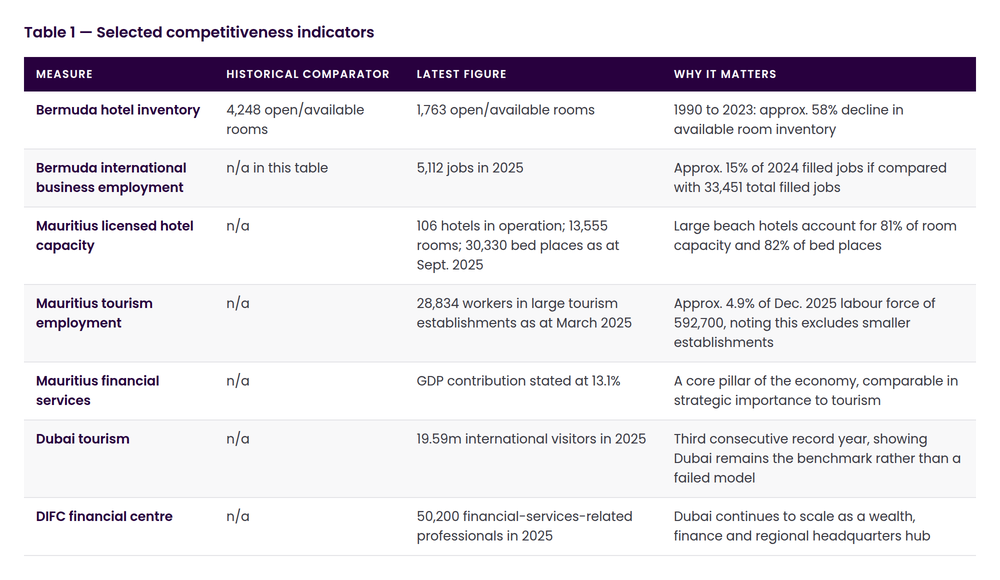
The numbers tell the story more brutally than any politician would dare. Bermuda’s open or available hotel room count stood at 4,248 in 1990. By 2023 it was 1,763. That is not a cyclical downturn. It is a structural loss of capacity. International business survived, and indeed today employs more than 5,000 people, because it is far less labour-intensive than hotels and because Bermuda built a specialised niche in insurance and reinsurance. Tourism did not have that luxury.
Mauritius is not Bermuda. It is larger, poorer, more diverse and more ambitious. But it is vulnerable to the same disease: the slow conversion of competitiveness into complacency.
The wrong benchmark
For years Mauritius liked to compare itself with Singapore. That comparison has now passed. Singapore is too far ahead in scale, infrastructure, execution and administrative discipline. The more relevant benchmark today is Dubai. Mauritius aspires, or should aspire, to become a credible alternative to Dubai for international families, entrepreneurs, regional headquarters, funds, family offices and high-value services seeking a stable base between Africa, Asia and Europe.
That is not a fantasy. Mauritius has real advantages: time zone, language, legal institutions, political stability, lifestyle, bilingual professionals and an established financial centre. It also has beaches, schools, health care, residential real estate and a quality of life that can appeal to internationally mobile families. In a world where capital is increasingly footloose, those assets matter.
But Dubai is the benchmark, not the backdrop. Dubai welcomed 19.59 million international visitors in 2025, a third consecutive record year. DIFC reported more than 50,000 financial-services-related professionals in 2025. Its appeal to capital is not accidental. It is the product of tax policy, infrastructure, speed, aviation connectivity, regulatory ambition and a relentless effort to make itself the easiest place in the region to do business.
The geopolitical uncertainty surrounding the Gulf, sharpened by the foreign-policy direction of President Donald Trump’s second administration, should have created an opening for Mauritius. This is not a claim about Dubai’s decline. It remains one of the world’s most dynamic business hubs. The more serious point is that uncertainty makes wealthy families and companies diversify. They may keep Dubai, but they will look for a second base. Mauritius should have positioned itself as that base: familiar enough for global capital, stable enough for families, and attractive enough for entrepreneurs.
What the Budget signals
Instead, the Budget sends the opposite signal.
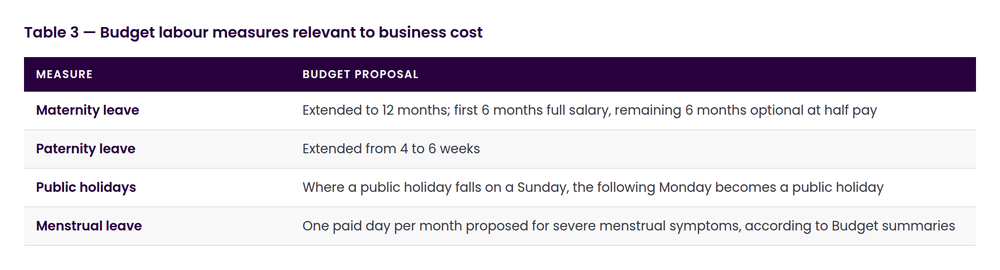
At precisely the moment when Mauritius should be asking how to become the Indian Ocean’s Dubai, it is making itself more expensive to employ people, more rigid as a labour market and less distinctive as a tax jurisdiction. Maternity leave is proposed to rise to 12 months. Paternity leave is to increase from four to six weeks. Where a public holiday falls on a Sunday, the following Monday is to become a public holiday. A new paid menstrual leave entitlement is proposed. Individually, each measure can be defended in human terms. Collectively, they alter the cost and predictability of employing labour in a hotel, a restaurant, a bank, a call centre or a growing international business.
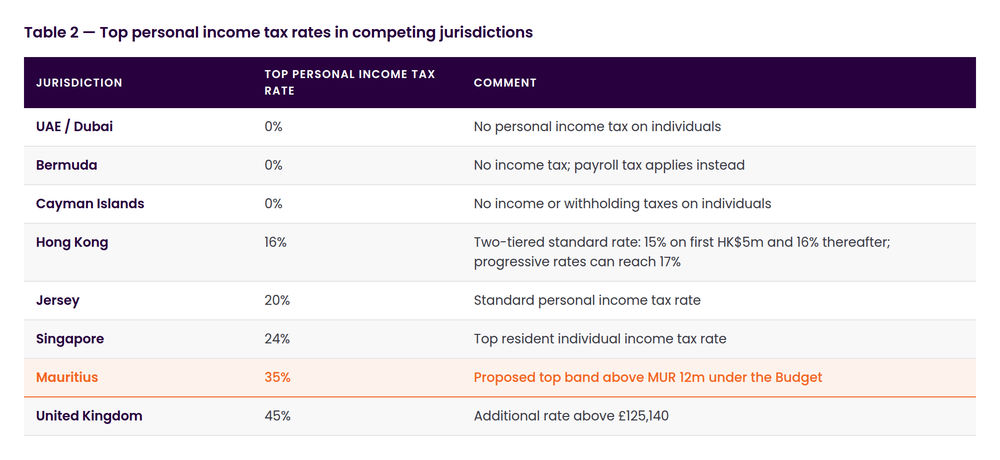
The tax signal is equally damaging. Mauritius built part of its international appeal on simplicity and moderation. A 35% top personal income tax band on chargeable income above MUR 12m changes the message. It tells the internationally mobile entrepreneur that Mauritius is no longer trying to be a low-tax, high-opportunity platform. It tells the fund manager, the regional executive and the family office principal that Mauritius is moving away from Dubai, not towards it.
A stark comparison
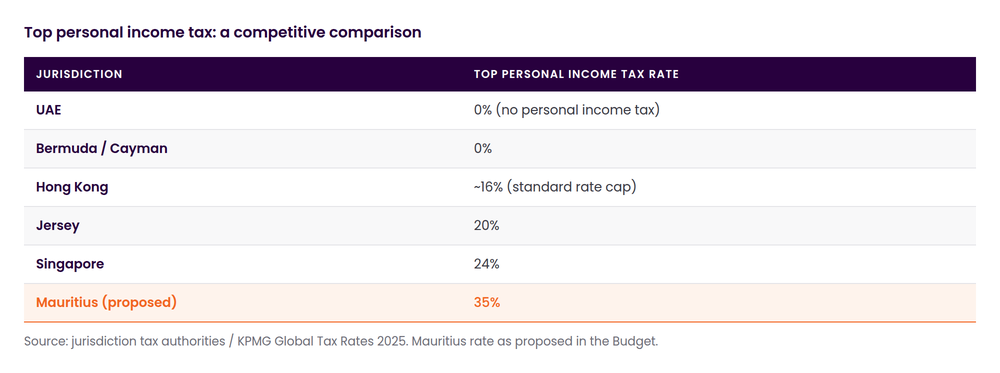
The comparison is stark. The UAE has no personal income tax. Bermuda and Cayman impose no income tax on individuals. Hong Kong caps salaries tax broadly at 16% on income above HK$5 million under its two-tiered standard-rate system. Singapore’s top resident rate is 24%. Jersey’s standard personal income tax rate is 20%. Mauritius now proposes 35%. Among jurisdictions that compete for mobile capital and talent, that is not a badge of fairness. It is a warning label.
Redistribution without competitiveness
The defenders of the Budget will say that Mauritius needs revenue and social protection. Of course it does. But redistribution without competitiveness is merely delayed austerity. The Government cannot promise more leave, more entitlements and more tax while assuming investors will remain because Mauritius is pleasant. Capital does not have a passport. Entrepreneurs do not owe allegiance to a jurisdiction that makes their lives harder. Hotels cannot pass every labour cost to tourists who can choose the Maldives, Seychelles, Zanzibar, Dubai or Greece. Financial businesses can move functions in months.
The real danger is not an immediate collapse. Bermuda’s warning is subtler. Decline starts with investment not made, hotels not refurbished, jobs not created, headquarters not opened, families not relocating and young people quietly planning their exit. No minister announces that moment. It appears years later in lower growth, weaker productivity and a smaller private sector carrying a heavier public promise.
Still winnable
Mauritius has not yet lost this battle. But it is choosing the wrong opponent and the wrong playbook. If the ambition is to compete with Dubai, policy must be judged against Dubai. Does this Budget make Mauritius easier to do business in than Dubai? Does it make Mauritius more attractive to high-net-worth families than Dubai? Does it make hiring easier, taxes more competitive, regulation faster, infrastructure better and government more predictable? If the answer is no, then the Budget is not a strategy. It is political theatre dressed as social progress.
Mauritius still has the chance to become the Indian Ocean’s most credible alternative to Dubai. Geography, language, stability and lifestyle are already in its favour. What it lacks is not potential but policy discipline. The tragedy of this Budget is not that it will destroy Mauritius tomorrow. It is that it may prevent Mauritius from discovering what it could have become.
Bermuda’s mistake was not that it became poor. It did not. Its mistake was that it allowed one of its great industries to fade while convincing itself that prosperity was permanent. Mauritius should not repeat that conceit.
Mauritius — 25 June 2026
Author’s note: the author lived in Bermuda in the 1980s and has lived in Mauritius for almost two decades.
David Rawson-Mackenzie
Founder and Managing Director, Centurion Group
Appendix: numbers behind the argument
The figures below are included to support the article. Some comparisons are necessarily imperfect because each jurisdiction classifies tourism, employment and financial services differently. The point is not mathematical symmetry; it is strategic direction.
Important information
This article is for information purposes only. It reflects the personal view of the author and does not constitute investment, tax or legal advice, nor a recommendation to adopt any course of action. Tax treatment depends on the individual circumstances of each client and may be subject to change. Professional advice should be taken before acting on anything set out here.
Marketing materials may include AI-assisted content. Every document is thoroughly reviewed, verified, and approved by Centurion Group before release.
© 1995–2026 Centurion Group. All Rights Reserved.